VA Renovation Loan Lenders: How to Find One for Your Project
Looking for a VA renovation loan? See if you qualify in 30 seconds. No credit pull. The short version Finding a lender for a VA
Carlos Scarpero, VA Mortgage Specialist, NMLS 1674385

You're trying to buy a property and it includes more than one parcel or lot number. Maybe you want the extra acreage behind the house, or there are two structures on adjacent lots. The good news is that a VA loan can cover multiple parcels, but there are rules, practical limits, and plenty of lender interpretation that can make the difference between smooth approval and a denial. This post breaks down what the VA requires, how underwriters actually treat multiple parcels, and what steps you should take to avoid surprises. And if you landed here asking the other version of the question, whether you can own more than one property at a time with a VA loan on each, the answer is also yes, with enough entitlement left and the income to qualify for both payments. That half of the answer starts right below.
Yes. This is the other question people are asking when they land on this page, and the answer is that nothing in VA's rules limits you to one VA loan at a time. Two things have to be true. You need enough entitlement left to support the new loan, and you have to qualify for both house payments under the lender's underwriting.
The new home has to be one you will occupy. VA financing is for a primary residence, so you cannot use your benefit to buy a pure investment property. What you can do is move, keep the first house, and rent it out.
VA Handbook Excerpt
“A Veteran with an existing VA-guaranteed loan using $55,000 of their guaranty entitlement is moving to another state and wishes to purchase a new home. The Veteran has opted to retain their existing VA-guaranteed loan; therefore, the entitlement used on that loan cannot be restored.”
That is VA's own example of a veteran holding two VA loans. Keeping the first home is allowed. The consequence is that the entitlement on the first loan stays charged, so the second loan runs on what is left.
Source: VA Lender’s Handbook (Pamphlet 26-7) – Chapter 3, The VA Loan and Guaranty
For a loan above $144,000, your available guaranty is 25 percent of the one-unit conforming loan limit in the county you are buying in, reduced by the entitlement still charged to the loan you are keeping. Multiply what is left by four and you have the purchase price you can cover with no down payment.
Run my numbers from Ohio. The 2026 one-unit limit here is $832,750, so full guaranty is $208,187. If your Certificate of Eligibility shows $88,412 charged to the house you are keeping, you have $119,775 of guaranty left, which supports about $479,102 with nothing down. Buy above that and VA expects 25 percent of the overage in cash.
You do not have to do this by hand. Put your county, your entitlement charged and the purchase price into the VA bonus entitlement calculator and it prints the down payment, if any.
Take the 30 second mortgage quiz to see if you qualify

Three paths, and the entitlement math is what separates them.
VA Handbook Excerpt
“One-time restoration where the prior VA loan has been paid in full, but the Veteran has not disposed of the property securing the loan. The Veteran may obtain restoration of the entitlement used on the prior loan in order to purchase a different property, one time only.”
There is a one-time exception if you refinanced the first home out of its VA loan but still own it. You can restore that entitlement once. After that, any future restoration requires disposing of every property you bought with a VA loan.
Source: VA Lender’s Handbook (Pamphlet 26-7) – Chapter 2, Veteran's Eligibility and Entitlement
If VA paid a claim on a loan of yours, that amount stays charged against your entitlement until the loss is repaid. You can still use the benefit again, but on the remaining entitlement rather than the full amount.
VA Handbook Excerpt
“Entitlement charged on a foreclosed loan cannot be restored until VA's loss on the loan has been fully repaid.”
Two options. Repay VA's loss and get the entitlement back, or buy on what is left and plan for a down payment if the price runs above it. Your Certificate of Eligibility shows the amount charged.
Source: VA Lender’s Handbook (Pamphlet 26-7) – Chapter 2, Veteran's Eligibility and Entitlement
Credit timing is a separate question from entitlement, and it is covered in getting a VA loan after a foreclosure.
One more thing that trips people up: the underwriting side. Holding two mortgages means the lender counts both payments unless rental income offsets the first one. VA's handbook sets the rules for using that rent, but individual lenders add their own reserve and documentation requirements on top. Those extras are overlays, not VA rules, and they differ from lender to lender.
The starting point is the VA Handbook, Chapter 12, Minimum Property Requirements. The core principle to remember is this: the property must be a single, readily marketable real estate entity.
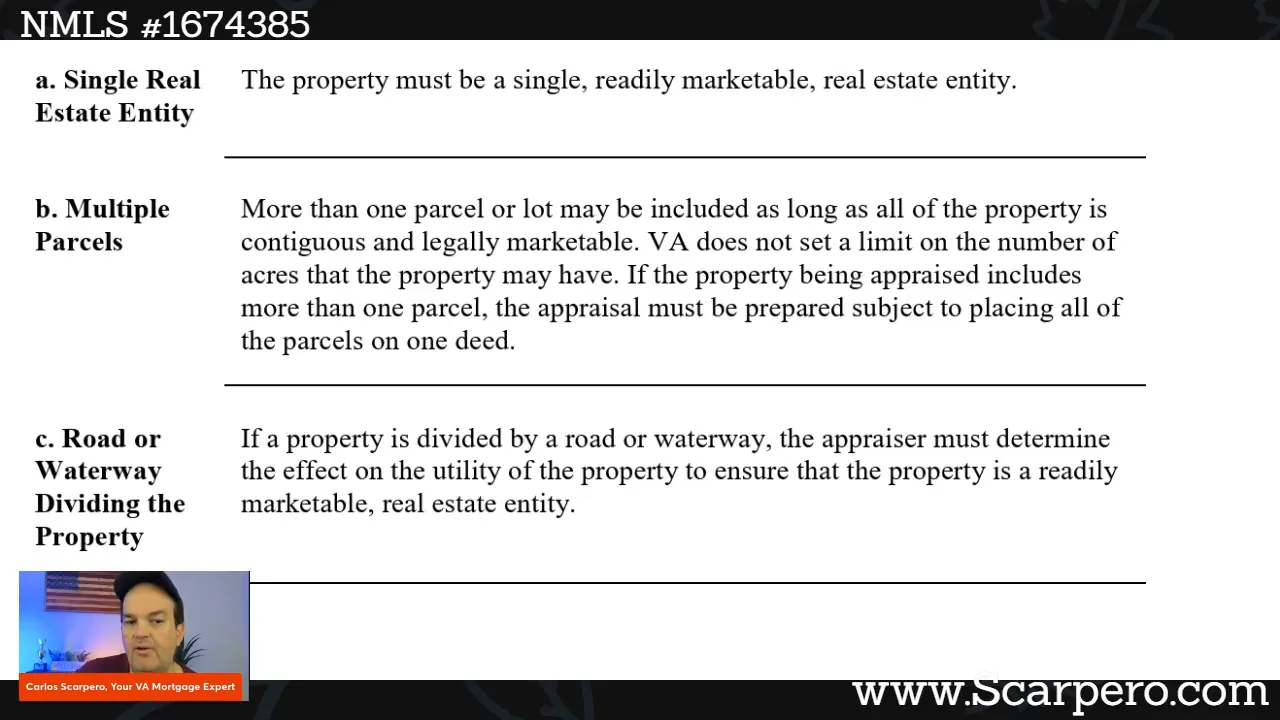
Although VA guidance is clear in principle, lenders and underwriters often apply additional interpretation. Below are the common scenarios and how they typically play out.
If all structures sit on a single lot number, most lenders treat the property as a multiunit property. VA allows up to four units on a single loan. That means a fourplex, two duplexes on the same lot, or a main house with accessory units on the same parcel are usually fine.
You must occupy one of the units as your primary residence, and the other units can be rented. This is one of the clearest “yes” situations you can encounter.
If the seller is including an adjacent vacant lot that is contiguous to the primary lot, lenders commonly allow the parcels to be combined into a single VA loan. Think of it as buying the house and a larger backyard in one transaction.
Two practical requirements here are that the parcels are contiguous and that the title work can place both parcels on the same deed for the loan and appraisal.
When you try to buy two separate houses on two separate lot numbers as a single transaction, lenders often push back. Why? Because that can look like two independent real estate transactions packaged together.
For example, one real-life situation involved a main house on one lot and a neighboring lot with a mobile home. The lender viewed those as two distinct transactions. They requested separate closings: one for the lot and house, one for the lot with the mobile home. If the neighboring mobile home lot were vacant instead, many lenders would accept it, because a vacant lot combined with the primary lot usually reads as one marketable entity.
The VA handbook explicitly allows parcels divided by a road or waterway if the appraiser determines the division does not impair the property’s utility. In practice, appraisers and underwriters will focus on how the division affects marketability. If the divided layout makes the property awkward to sell, lenders may be reluctant.
Take the 30 second mortgage quiz to see if you qualify
Whether you are the buyer or the agent, being proactive with documentation will save time and reduce the chance of denial.
Yes. The VA allows multiple contiguous parcels to be included on a single VA loan as long as the combined property is a single, readily marketable real estate entity. Title and appraisal requirements must be met, including combining parcels on one deed for the appraisal.
The VA handbook does not set an acreage limit. Practical limits come from lender policies, appraisal concerns, and whether the property remains marketable. Some lenders might impose acreage limits under their own guidelines.
The appraiser must evaluate whether the division affects the utility and marketability of the combined property. If the appraiser determines the divided layout still reads as one marketable entity, the parcels can be included.
It depends. If the mobile home is considered a separate, habitable structure on its own lot, a lender may view that as two transactions. If the lot is vacant or the mobile home is demolished, approval is more likely. Lender interpretation varies.
Ask for the specific reason in writing and then get a second lender opinion. Different lenders and underwriters interpret VA rules differently. A broker who shops multiple lenders can often find a program that will accept the parcels.
Yes, as long as you have entitlement left and you qualify for both payments. The second home has to be one you will occupy. There is no VA rule capping the number of VA loans at two, but entitlement runs out quickly past that.
No. You can keep it and rent it. Selling and paying the loan off is what restores the entitlement, so keeping the house means the next purchase runs on your remaining entitlement.
Only if the purchase price is above four times your remaining guaranty. Check it with the bonus entitlement calculator.
The VA allows multiple contiguous parcels on one loan, but the practical outcome depends on title, appraisal, and lender interpretation. If your deal includes multiple lot numbers, verify early with the lender, coordinate title work so parcels can be combined on one deed, and be prepared to shop lenders if you hit resistance. With the right documentation and the right lender, you can often bundle extra acreage or adjacent vacant lots into a single VA loan, just make sure you plan for the appraisal and title steps up front.

Looking for a VA renovation loan? See if you qualify in 30 seconds. No credit pull. The short version Finding a lender for a VA

New to VA loans? See if you qualify in 30 seconds. No credit pull. The VA Lender’s Handbook is the actual rulebook behind every VA
The short version Most of what you read online about VA renovation loan “rules” is actually describing one lender’s program restrictions, not VA requirements. VA’s